

Couple Hoodie Fabric, Quality and Wash Care Guide: How to Keep Your Hoodies Looking Great
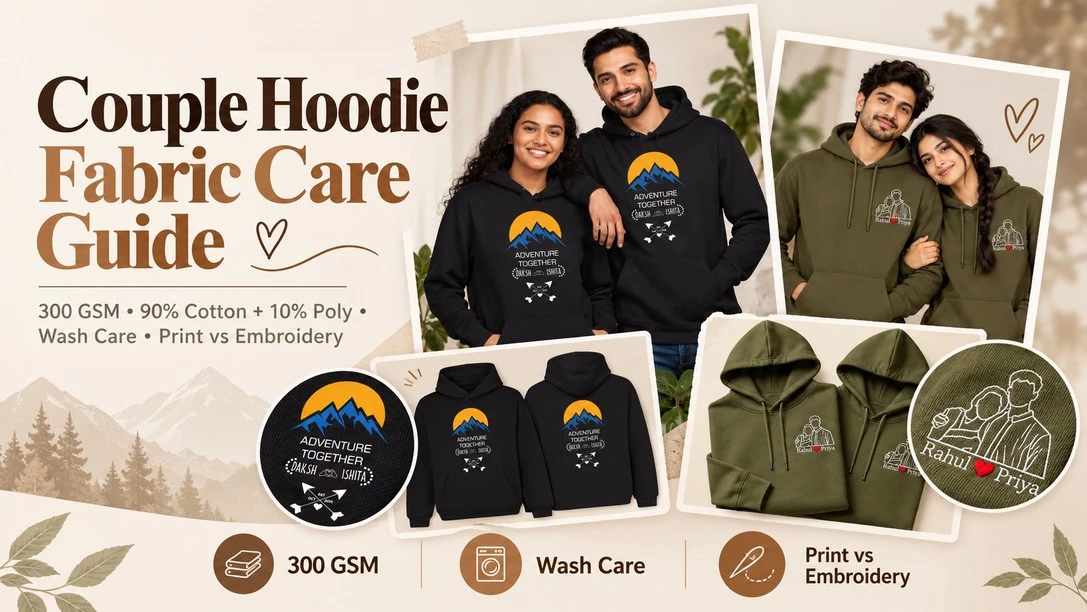
Personalized couple hoodies are more than matching outfits. Whether they feature your names, initials, anniversary date, or a favourite photograph, they can become a meaningful part of your everyday wardrobe.
But while choosing the right design is important, understanding hoodie fabric quality and proper wash care is equally essential.
What does 300 GSM mean? Is cotton-blend fabric better for everyday hoodies? How should you wash personalized hoodies without damaging the print? And how can you reduce shrinking, fading, and wear over time?
This couple hoodie fabric, quality and wash care guide answers these questions with practical tips for choosing, washing, drying, and maintaining personalized hoodies.
Whether you own printed matching hoodies or embroidered line art designs, learning how to care for them can help preserve their comfort, fit, and appearance.
Quick Guide: How to Wash Personalized Couple Hoodies
The safest everyday approach is to wash personalized hoodies inside out in cold water, use a mild detergent, avoid harsh chemicals, and keep high heat away from the printed or embroidered design.
Follow these steps:
- Turn your hoodie inside out before washing to reduce friction against the printed or embroidered surface.
- Use cold water and a gentle machine-wash cycle.
- Wash with similar colours to reduce the possibility of colour transfer.
- Choose a mild detergent and avoid bleach or harsh cleaning products.
- Air-dry when practical, or use a low tumble-dryer setting if the garment’s care instructions permit it.
- Never iron directly over personalized printing or embroidery.
- Store your hoodie only when completely dry to prevent unwanted odours and moisture buildup.
Always follow the care label supplied with your specific hoodie if its instructions differ.
What Fabric Is Used for Personalized Couple Hoodies?
The fabric determines much of a hoodie’s comfort, appearance, feel, and suitability for different temperatures.
Common hoodie fabrics include cotton, polyester, cotton-polyester blends, and different types of fleece or brushed-knit constructions.
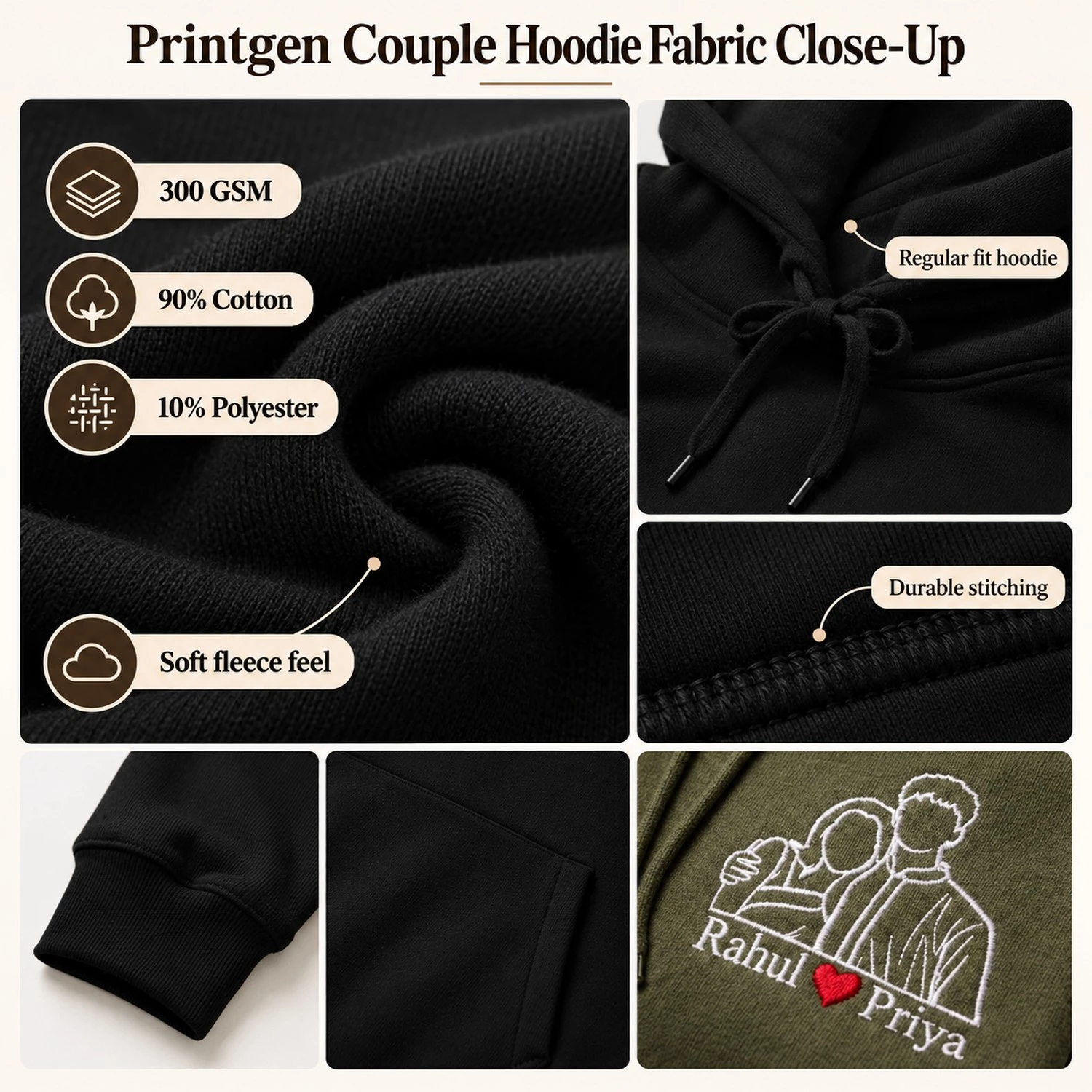
Printgen’s selected personalized couple hoodie products use a 90% cotton and 10% polyester fabric blend with a weight of 300 GSM.
These products also feature a regular unisex fit, making them suitable for coordinated outfits while allowing both partners to select their preferred sizes.
Understanding 90% Cotton and 10% Polyester Hoodies
Cotton and polyester have different characteristics.
Combining them allows manufacturers to balance comfort and fabric performance.
What does cotton contribute?
Cotton is known for its softness, absorbency, and breathability.
In hoodies, cotton-rich fabrics can offer a comfortable feel against the skin and are suitable for everyday casual clothing.
What does polyester contribute?
Polyester is a synthetic fibre valued for its strength, shape retention, and resistance to certain forms of wrinkling.
When blended with cotton, it can contribute to the fabric’s dimensional stability and durability.
Why combine cotton and polyester?
A cotton-polyester blend combines some of the desirable properties of both fibres.
For personalized couple hoodies, this can offer a balance of:
- Comfortable everyday wear
- Soft fabric feel
- Good shape retention
- Practical washing and maintenance
- Suitability for casual outings and travel
However, fabric quality also depends on yarn, knitting, finishing, stitching, and manufacturing quality—not simply the percentage of cotton.
Is 90% Cotton Better Than 100% Cotton for Hoodies?
Neither option is automatically better.
A 100% cotton hoodie may appeal to someone who prefers natural fibres, while a cotton-polyester blend can provide different characteristics in terms of shape retention and maintenance.
The ideal fabric depends on your preferences, intended use, climate, and the actual construction of the garment.
For matching couple hoodies, comfort, fit, stitching quality, and the suitability of the fabric for printing or embroidery are all worth considering.
What Does 300 GSM Mean in Hoodie Fabric?
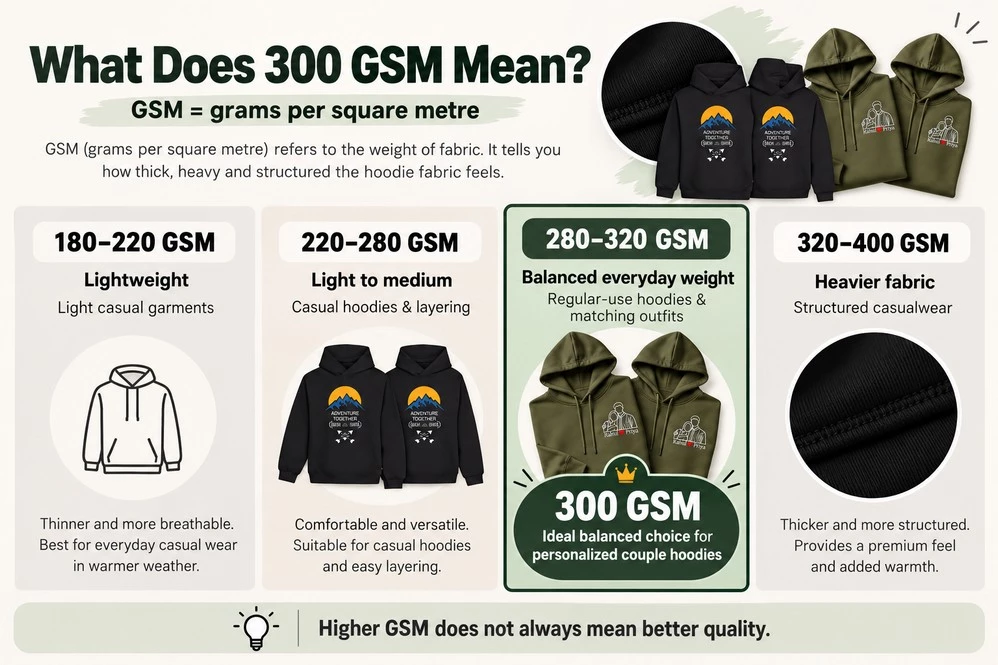
When comparing hoodie quality online, you may notice specifications such as 240 GSM, 280 GSM, 300 GSM, or 350 GSM.
GSM stands for grams per square metre.
It measures the weight of one square metre of fabric.
For example, a 300 GSM fabric weighs approximately 300 grams per square metre of material.
A higher GSM generally indicates more fabric mass per unit area, although fabric thickness, softness, and warmth also depend on other factors.
Hoodie GSM Comparison Guide
| Fabric Weight | General Characteristics | Common Uses |
|---|---|---|
| 180–220 GSM | Relatively lightweight | Light casual garments and some sweatshirt fabrics |
| 220–280 GSM | Light-to-medium sweatshirt weight | Casual hoodies and layering |
| 280–320 GSM | Substantial everyday sweatshirt fabric | Regular-use hoodies and matching outfits |
| 320–400 GSM | Heavier fabric construction | Heavyweight hoodies and structured casualwear |
| 400+ GSM | Very heavyweight fabric | Selected heavyweight fashion garments |
These ranges are general comparisons rather than standardized apparel classifications. Fabrics with the same GSM can feel different.
Is 300 GSM Good for Couple Hoodies?
A 300 GSM cotton-blend fabric can be a practical choice for everyday couple hoodies.
It offers a substantial fabric weight without automatically being as heavy as some 400 GSM or higher constructions.
This makes it worth considering for casual outings, travel, photoshoots, and cooler-weather layering.
Printgen uses 300 GSM fabric in selected personalized couple hoodie designs featuring names, initials, printed graphics, and photo-inspired artwork.
Does Higher GSM Always Mean Better Quality?
No.
Although fabric weight can influence the feel and structure of a hoodie, it does not measure every aspect of quality.
A well-constructed 280 GSM hoodie can perform better than a poorly made 350 GSM hoodie.
When comparing personalized hoodie quality, look at:
- Fabric composition
- Surface texture
- Stitching consistency
- Seam finishing
- Ribbed cuffs and hems
- Hood construction
- Print or embroidery quality
- Fit and size consistency
A quality hoodie should balance fabric, construction, personalization, and comfort—not just GSM.
How to Check the Quality of Personalized Couple Hoodies
Personalized hoodies have two important quality elements: the garment itself and the artwork applied to it.
Both should be considered before choosing a design.
1. Fabric Feel and Texture
A comfortable hoodie should feel suitable for the intended use.
Check whether the material feels excessively rough, unusually stiff, or inconsistent.
The surface should also be appropriate for the type of personalization.
For example, fine lettering or line art may require a sufficiently stable and even fabric surface for clear reproduction.
2. Stitching and Seam Quality
Inspect the stitching around:
- Shoulders
- Sleeves
- Side seams
- Hood attachment
- Kangaroo pocket
- Ribbed cuffs and hem
Look for consistent seams, secure stitching, and the absence of obvious loose or broken threads.
The quality of these details can influence how the hoodie withstands regular wear and washing.
3. Fit and Size Consistency
A well-made hoodie should match its published measurements reasonably closely, allowing for normal manufacturing tolerances.
For matching couple hoodies, check sizes separately for both partners.
Do not assume that two people should choose identical size labels simply because the garments are part of a matching set.
4. Print Clarity
When choosing printed hoodies, inspect the artwork.
Names and dates should be readable, and details should appear clear at the intended size.
Printed artwork should not have obvious production defects such as missing sections, unexpected alignment errors, or poor edge definition.
Different printing techniques may create different surface textures, so a soft-feeling print is not the only indicator of quality.
5. Embroidery Quality
For embroidered couple hoodies, inspect how clearly the stitched artwork represents the intended design.
Good embroidery should have consistent stitching suited to the artwork.
Check for loose threads, excessive puckering, and details that are difficult to distinguish.
Very intricate artwork may need simplification to work well with embroidery.
Explore Printgen’s Line Art Couple Hoodies for photo-inspired embroidered designs.
Printed vs Embroidered Couple Hoodies: Does Wash Care Differ?

Yes. Printed and embroidered designs can require slightly different precautions because the artwork is attached to the garment in different ways.
Caring for Printed Couple Hoodies
Printed couple hoodies may feature names, initials, anniversary dates, illustrations, or matching graphics.
To help protect the printed design:
- Turn the hoodie inside out before washing.
- Use cold water and a mild detergent.
- Avoid heavy rubbing directly over the design.
- Avoid bleach and aggressive stain-removal products.
- Keep direct ironing heat away from the print.
- Use a low drying temperature if tumble drying is permitted.
Excessive heat, friction, and harsh cleaning can contribute to print deterioration, depending on the printing method.
If you prefer text-based personalized designs, explore Printgen’s Name Print Couple Hoodies.
Caring for Embroidered Couple Hoodies
Embroidery uses thread to create a design on the fabric.
It can be used for initials, names, small decorative elements, and personalized line art.
To care for embroidered hoodies:
- Wash inside out.
- Choose a gentle cycle.
- Avoid washing with garments containing exposed hooks or sharp accessories.
- Do not scrub the stitched area aggressively.
- Avoid pulling loose threads.
- Keep direct high ironing heat away from the embroidery.
- Allow the hoodie to dry completely before storing.
If a thread becomes loose, avoid pulling it because this can disturb nearby stitches.
For damaged embroidery, professional repair or guidance from the seller may be appropriate.
Print vs Embroidery Wash Care Comparison
| Care Requirement | Printed Hoodie | Embroidered Hoodie |
|---|---|---|
| Cold washing | Recommended | Recommended |
| Inside-out washing | Recommended | Recommended |
| Gentle wash cycle | Recommended | Recommended |
| Mild detergent | Recommended | Recommended |
| Bleach | Avoid | Avoid unless specifically permitted |
| Direct ironing on design | Avoid | Avoid |
| Heavy rubbing | Avoid | Avoid |
| Loose-thread care | Not usually applicable | Important |
| Drying | Air-dry or permitted low heat | Air-dry or follow care label |
How to Wash Personalized Couple Hoodies in a Washing Machine

Washing your personalized hoodie correctly can help reduce avoidable damage to the fabric and design.
Here is a practical step-by-step method.
Step 1: Check the Care Label
Before washing, check the garment’s care label and any product-specific instructions.
Fabric composition, printing method, embroidery, and finishing can affect the recommended washing process.
If your hoodie has special embellishments, those instructions should take priority.
Step 2: Turn the Hoodie Inside Out
Turn the hoodie so that the printed or embroidered design faces inward.
This helps reduce direct friction between the artwork, other clothes, and the washing-machine drum.
It may also help protect the outer fabric surface from unnecessary abrasion.
Step 3: Separate Similar Colours
Wash dark hoodies with other dark garments and light hoodies with suitable light-coloured clothing.
For a newly purchased coloured hoodie, consider washing it separately the first time to reduce the risk of colour transfer.
Avoid mixing delicate personalized hoodies with items containing rough hardware, exposed zippers, or hook-and-loop fasteners.
Step 4: Use Cold Water
Cold water is a sensible choice for many printed cotton-blend hoodies.
It helps limit the heat-related stress associated with shrinkage and certain types of print deterioration.
Printgen’s published wash-care instructions recommend cold machine washing.
Step 5: Choose a Gentle Wash Cycle
A gentle cycle generally exposes the garment to less mechanical agitation than an intensive wash.
This can be helpful for maintaining printed graphics, fine embroidery, and fabric appearance.
Avoid overloading the washing machine because tightly packed garments may not wash or rinse evenly.
Step 6: Use a Mild Detergent
Choose a detergent suitable for the fabric and garment colour.
Use the quantity recommended on the detergent packaging.
Avoid bleach, strong cleaning agents, and unnecessarily aggressive stain treatments.
Step 7: Remove the Hoodie Promptly
Once the wash cycle finishes, remove the hoodie without leaving it wet inside the machine for a long period.
Gently reshape the garment if necessary before drying.
Avoid pulling heavily on the sleeves, hem, or hood while the material is wet.
Can You Hand Wash Personalized Couple Hoodies?
Yes, hand washing can be a gentle option when the fabric care label permits it.
It may be particularly useful for hoodies with delicate embroidery or decorative elements.
How to Hand Wash a Personalized Hoodie
- Fill a clean basin with cold water.
- Add a small amount of mild detergent.
- Turn the hoodie inside out.
- Gently move it through the water without aggressive scrubbing.
- Pay attention to areas such as cuffs and underarms.
- Rinse thoroughly with clean water.
- Gently press out excess water without twisting the printed or embroidered area.
- Reshape and dry according to the care label.
Avoid prolonged soaking, especially for dark or strongly coloured garments.
Important: Hand washing does not automatically prevent damage. Excessive scrubbing, twisting, or harsh cleaning products can still affect the fabric and artwork.
How to Dry Personalized Hoodies Without Damaging the Print
Drying is an important part of hoodie maintenance.
Excessive heat can contribute to shrinkage, surface changes, or damage to certain printing methods.
Air Drying Personalized Hoodies
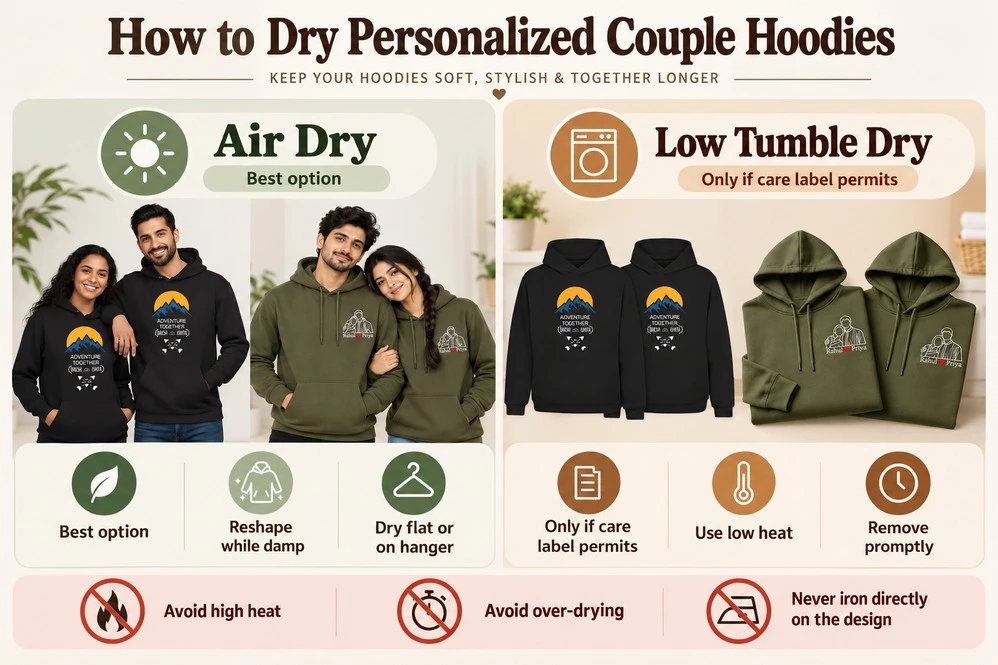
Air drying is a useful low-heat option for many personalized hoodies.
After washing:
- Gently reshape the hoodie.
- Place it flat on a suitable drying surface or hang it in a way that supports its weight.
- Choose a well-ventilated area.
- Avoid prolonged exposure to harsh direct sunlight, especially for darker colours.
- Allow it to dry completely before storing.
For heavier wet garments, drying flat can help reduce stretching around the shoulders.
Can You Tumble Dry Personalized Hoodies?
Printgen’s published wash-care instructions permit tumble drying on low heat for selected products.
However, the garment’s own care label should always take priority.
If you use a tumble dryer:
- Select a low-heat setting.
- Avoid high-temperature drying.
- Do not overdry the garment.
- Remove it promptly.
- Let it cool before folding.
Air drying remains a practical alternative when you want to avoid unnecessary heat exposure.
Can Sunlight Fade Hoodie Colours?
Prolonged exposure to strong direct sunlight can contribute to colour fading in some fabrics and dyes.
This is particularly noticeable on certain dark-coloured garments.
For regular drying, a shaded and well-ventilated area may help reduce unnecessary exposure.
How to Prevent Personalized Hoodies from Shrinking
Hoodie shrinkage is a common concern, especially when a garment contains a high percentage of cotton.
Cotton-rich fabrics can change dimensions during washing and drying, depending on how the material was processed and cared for.
Why Do Hoodies Shrink?
Shrinkage can be influenced by several factors:
- Fibre composition
- Fabric construction
- Manufacturing and finishing processes
- Water temperature
- Washing agitation
- Drying temperature
Cotton-polyester blends may have different dimensional stability from pure cotton fabrics, but this does not guarantee that they will never shrink.
Tips to Reduce Hoodie Shrinkage
- Wash using cold water.
- Avoid high-temperature drying.
- Follow the care label.
- Do not stretch or twist the garment aggressively while wet.
- Reshape it gently before air drying.
- Avoid unnecessary repeated hot wash cycles.
Can a 300 GSM hoodie shrink?
Yes. GSM measures fabric weight per square metre, not shrink resistance.
A 300 GSM hoodie may still experience some dimensional change depending on its construction and care.
For choosing the correct hoodie size before ordering, refer to your product’s official size chart.
How to Stop Hoodie Prints from Cracking, Peeling or Fading
Names, anniversary dates, and illustrations are often the most meaningful parts of personalized couple hoodies.
Protecting the design helps maintain the garment’s appearance.
Why Do Hoodie Prints Crack or Peel?
Possible causes include:
- Excessive heat
- Repeated friction
- Stretching across printed areas
- Harsh detergents
- Incorrect ironing
- Production or application defects
The exact risks depend on the printing technique.
How to Care for Printed Names and Dates
Text-based designs often contain narrow letters and fine details.
To protect them:
- Wash inside out.
- Avoid aggressive rubbing.
- Use cold water.
- Keep hot irons away from the lettering.
- Avoid stretching the printed area unnecessarily.
- Follow the garment’s recommended drying instructions.
The same precautions can apply to printed anniversary dates, initials, and matching couple graphics.
How to Care for Vector Art Hoodies
Vector-style couple hoodie designs may contain multiple colours and fine illustrated details.
Careful washing can help preserve the appearance of the printed artwork.
Avoid using harsh chemicals directly on the print and do not expose the illustrated area to direct ironing heat.
Browse Printgen’s Vector Art Couple Hoodies to explore photo-inspired printed designs.
What If a Hoodie Print Is Already Peeling?
If a print begins peeling or cracking, avoid pulling loose sections or applying an iron directly to the damaged area.
Some printing techniques may have specific repair processes, while others cannot be restored effectively at home.
Contact the seller for guidance if the issue appears to be a production defect or occurs unusually early.
How to Remove Stains from Personalized Hoodies
Food spills, drinks, dust, and everyday marks can happen even when you’re careful.
The important thing is to treat the stain without damaging the printed or embroidered design.
Step 1: Act Early
Gently blot a fresh spill with a clean cloth.
Avoid rubbing the stain aggressively because this can spread it or damage the fabric surface.
Step 2: Check the Fabric and Care Label
Different stains require different treatments, and not every cleaner is safe for coloured or printed fabric.
Check the label before applying a product.
Step 3: Use a Mild Cleaning Solution
For a suitable water-based stain, gently dab the affected fabric with a small amount of mild detergent diluted in cold water.
Test the treatment on a hidden area first, especially on dark or brightly coloured hoodies.
Avoid applying unknown stain-removal chemicals directly onto prints or embroidery.
Step 4: Rinse and Wash Gently
After pre-treating the affected area, wash according to the garment instructions.
Check whether the stain has disappeared before using a dryer, since heat may make some stains more difficult to remove.
Step 5: Dry Carefully
Air-dry or follow the care label’s permitted drying method.
For stubborn stains, consider a professional cleaner who has experience with decorated garments.
How to Keep Couple Hoodies Soft and Comfortable
Repeated washing, detergent buildup, and rough drying can affect how a hoodie feels.
Good maintenance can help the fabric remain comfortable for everyday wear.
Avoid Using Too Much Detergent
Excess detergent may not rinse out completely, leaving unwanted residue.
Use the amount appropriate for the wash load, soil level, and machine.
Avoid Harsh Washing Cycles
Intensive agitation can increase friction against the fabric.
Use a gentle cycle when appropriate for the garment.
Dry the Hoodie Correctly
High drying temperatures may affect the fabric’s feel and dimensions.
Consider air drying or a permitted low-heat tumble-dryer cycle.
Remove Surface Lint Gently
Lint or small fabric pills can sometimes appear after wear and washing.
If needed, use a suitable fabric-care tool gently, keeping it away from raised prints and embroidery.
Avoid pulling fabric pills aggressively by hand, as this may disturb nearby fibres.
How Often Should You Wash Matching Couple Hoodies?
There is no universal number of wears between washes.
Washing frequency depends on:
- How long you wore the hoodie
- Whether you wore an inner T-shirt
- The weather and temperature
- How much you perspired
- Whether the garment has visible stains or odours
A hoodie worn briefly over clean clothing in cool weather may not need washing immediately after every use.
However, if it becomes sweaty, stained, or noticeably dirty, it should be cleaned appropriately.
Avoid unnecessary washing, but do not delay cleaning when it is needed for hygiene.
How to Store Personalized Couple Hoodies Properly

Storage also affects the condition of your hoodie.
Make Sure the Hoodie Is Completely Dry
Do not fold or store a damp hoodie.
Trapped moisture can cause unpleasant odours and may encourage mildew in unsuitable storage conditions.
Fold Heavy Hoodies Neatly
Folding can help prevent long-term stretching around the shoulders, particularly for heavier garments.
Avoid placing excessive weight on raised printed or embroidered areas.
Store in a Clean, Dry Space
Choose an area protected from moisture, dust, and prolonged sunlight.
For seasonal storage, clean the garment first and allow it to dry completely.
Avoid Unnecessary Pressure on Artwork
Some printing techniques have raised or textured surfaces.
Avoid storing the hoodie in a way that creates prolonged pressure or friction against the artwork.
Common Couple Hoodie Wash Care Mistakes to Avoid
Proper care does not need to be complicated. Avoiding a few common habits can make a difference.
1. Washing in Very Hot Water
High temperatures can increase the risk of dimensional changes and may affect certain printed designs.
Choose cold water unless the care label specifically directs otherwise.
2. Ironing Directly Over Printed Names
Direct heat can damage some prints.
Never place a hot iron directly on printed artwork.
3. Using Bleach on Coloured Hoodies
Bleach can damage dyes, fibres, and printed designs.
Avoid it unless the garment instructions explicitly allow a particular treatment.
4. Washing with Rough Garments
Exposed zippers, hooks, or abrasive accessories can rub against delicate prints and embroidery.
Separate the hoodie from such items where practical.
5. Drying at High Heat
High-temperature drying may contribute to shrinkage or artwork deterioration.
Use the drying method recommended on the label.
6. Scrubbing Embroidery Aggressively
Strong rubbing may disturb embroidered threads.
Clean these areas gently.
7. Storing Hoodies While Damp
Moisture trapped in folded clothes can cause odours and other storage problems.
Always dry garments thoroughly before putting them away.
Couple Hoodie Fabric and Care: Frequently Asked Questions
Selected Printgen personalized couple hoodie products use 90% cotton and 10% polyester fabric with a weight of 300 GSM. Check the individual product description to confirm its specifications.
300 GSM can be a suitable fabric weight for a substantial everyday hoodie. However, GSM alone does not determine softness, warmth, durability, or overall quality.
Both fibres have useful characteristics. Cotton offers softness and breathability, while polyester can contribute strength and dimensional stability. A cotton-polyester blend combines some of these properties.
Yes. Printgen recommends cold machine washing inside out for selected personalized couple hoodies. Use a gentle cycle when appropriate and follow the care label.
Turn the hoodie inside out, use cold water with mild detergent, avoid bleach, and keep direct ironing heat away from the printed design.
Many embroidered hoodies can be machine washed on a gentle cycle if their care labels permit it. Turn the garment inside out and avoid rubbing or snagging the embroidered area.
Shrinkage is possible depending on the fabric, construction, and washing conditions. Cold washing and avoiding high dryer heat can help reduce the risk.
Selected Printgen hoodies allow tumble drying on low heat. Follow the individual care label and avoid high temperatures.
Check the garment care label. If ironing is permitted, avoid direct contact with printed or embroidered areas. Use an appropriate low-temperature method on unaffected fabric only.
Use cold water, wash inside out, avoid aggressive friction, and keep high heat away from the artwork. The lifespan of a print also depends on the printing technique and production quality.
Not necessarily. GSM indicates fabric weight per square metre. Stitching, yarn quality, fabric construction, finishing, and artwork application are also important.
Wash with similar dark colours, use cold water, avoid harsh detergents, and limit unnecessary exposure to intense sunlight during drying or storage.
Store them clean and completely dry in a suitable cupboard or drawer. Fold them neatly and avoid pressure or friction against delicate embroidered details.
Wash them when needed based on wear, perspiration, stains, and odour. Hoodies worn briefly over clean clothing may not require washing after every use.